On Saturday 3rd March 2018 I was privileged to participate in and complete IRONMAN New Zealand. What a awesome race, great town, welcoming locals, great volunteers and a awesome support crew. Right up there as the best race of the 10 IRONMAN races to date.
I do not say “privileged” lightly as just 4 month earlier I thought my running and triathlon days were over due to a persistent ankle issues. I had a ganglion cyst removed back in May 2017 which compromised by ankle stability making running impossible. After 4 months of rehabilitation there was little progress. In October I started making progress with the help of the Awesome Shena Dale Physiotherapy (Scarborough, Queensland). By late November I was jogging 10km, but real slow at 8 min/km. As that stage I had not done any running since October 2016 when the ankle issue started. I had also stopped cycling and swimming to improve recovery and decrease inflammation.
On December 3rd I support some of my coached athletes at IM Western Australia. The conditions were extreme with a shark scare, heat wave, forest fires and rampaging kangaroos. The race lit the spark and soon after I entered IM New Zealand well knowing it was going to take something special to have a reasonable race. And so the journey to IM #10 began.
As an experienced coach I knew a traditional program would not get me there. Yes I have experience and good base in my favour, but my muscular and aerobic systems were certain well below where they should be for a 20 week program, never mind 10 weeks.
Breaking down the physiological adaptions I needed to complete the 226 km I prioritised by discipline and energy system. This made it evident the run training was going to be the key. IRONMAN is about strength and durability, speed is secondary. A typical program would have 50% of volume as bike miles. As I had no time to ramp training to preferred volumes and my run strength being the weakest I made the call to switch the model a focus on run volume to give me leg strength and aerobic fitness. My Bike program was to focus on threshold and VO2max while limited aerobic relative to traditional programming.
Recovery was going to be pivotal as the program was going to high intensity that I would usually recommend as I was pretty much going straight into build phase for bike and a high ramp rate for run.
I listed the following key recovery non-negotiable strategies which I needed to meet in order for me to absorb the training needed:
- Average 7.5 to 8 hours sleep per night. Sleep is when the majority of physiological repair happen, it is when we get stronger.
- Fueling with carbohydrates causes oxidation and inflammation so no carbs for training sessions under 3 hours, Over 3 hours limited to 20 grams per hour. As I am fat adapted this was not a struggle.
- Consume high levels of multi-coloured non-starchy veg to maximise micronutrients pivotal in supporting hormone balance and recovery.
- Stick to a low carb, healthy fat way of eating to minimise inflammation and aid recovery.
- Introduce Intermittent fasting to ensure damaged cells were cleaned out through autophagy processes.
- Manage everyday stress head on. Emotional stress is a killer, limiting recovery, effecting decisions. Through mindfulness, working with mentors and simply facing up to and resolving stressful issues is key.
- Dial in my intuition and allow myself to choose what session to do depending on how I felt. Follow tight weekly targets and goals, but be flexible and dynamic on what I do each day. Used Heart Rate Variability as a guide
I honestly believe each of the above points were the enablers to the aggressive program I had set myself. The biggest lessons and successes came out of the above 7 points. I will be using these golden strategies going forward as general lifestyle rules!
The Training Plan:
Swim: As a reasonably strong, but not fast, swimmer a just did the essentials. Two to three swims a week, mostly endurance. Lots of paddle work, lots of 400m sets. Not much speed work. To be competitive I would need speed work, but not for this event.
Bike: I had no time for ramp up to big days on the bike. My longest ride was 4.5 hours (130km) however I did a 180km day on the wind trainer with two sessions 4 hours in the morning and 1:45 to the evening. My focus was on VO2 max to develop force and Threshold sets to develop power. 70% of volume was on the Wahoo KickR.
Run: I stated with MAF running only for the first 4 weeks. I did do a metabolic test with Jupiter Health to establish my aerobic threshold. This ended up being high value I it proved I was an outlier! 90% of people have an aerobic threshold 180 – their age. This would put me at a heart rate of 125! Though the metabolic testing we established my threshold is 139. This gave me an extra 14 beats to work with! My pace at this heart rate was a little under 8 min/km early in the program. Strict adherence to the limit saw it come down to 6:30 per km in this first phase. The next 6 weeks I kept 75% of volume at MAF, but introduce threshold work. These were 8 min to 20 min interval aimed a improving durability. Nothing fancy, just run, rinse repeat. Two long runs a week with the longest being 30km, the longest day being 4.5 hours made up of two half marathons. Oh, 4 weeks out I did a off road trail marathon, but real easy with lots of walking!
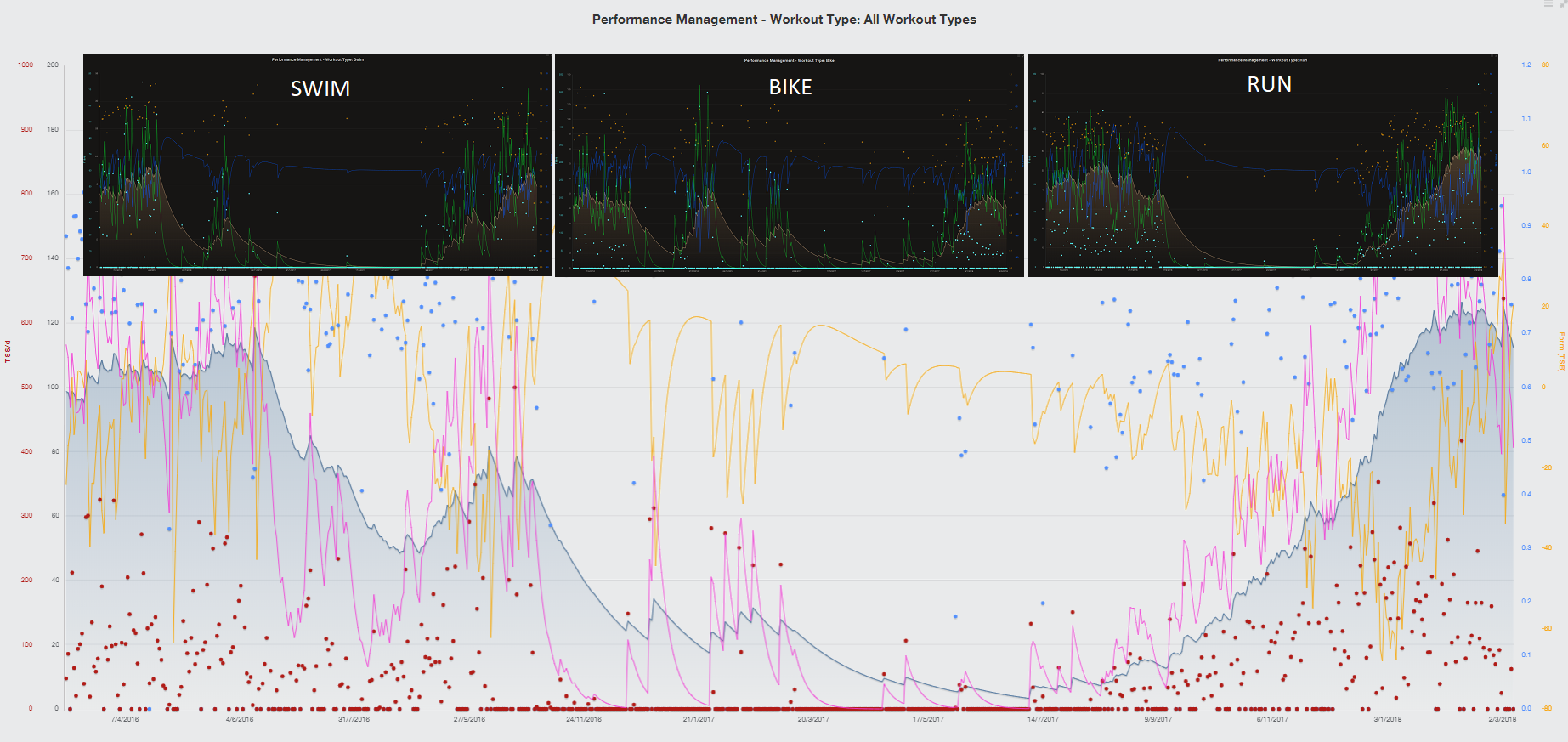
Volumes: Averaged 14 hours per week, biggest week being 19.5 hours
Race Day: Swim (3.8km): 1:09 | Bike (180km): 5:36 | Run (42.2 km): 4:31 | TOTAL (incl transition): 11:31
Swim: (Target 1:05-1:10 Actual: 1:09) Swim went as expected, steady pace, steady heart rate after the turmoil of the mass start.
Bike: (Target 5:45 Actual 5:36) Bike went better than expect. I thought I would struggle in the last 30km but felt strong throughout. The lesson to me is that the lack of long rides did not impact my ability to stay on power or aero late in the ride, in fact I am sure the increased threshold work help with these. (Fuel: 128 gram carbs [UCAN 80grams / Shotz gels 48 grams] and 48 grams fat [MCT Oil])
Run: (Target 4:20 Actual 4:31) My run was great through to 16km when my heart rate dropped from 138 to 125. I simply had no power. No nutritional issue, no muscle fatigue, just no power. I put this down to general accumulated fatigue due a lack of base volume the short program. I kept running at a jog, walked some aid stations and was able to lift the pace a little after 28km. I was a little disappointed with my run at the time but on reflection, given the short training program, I am really happy. (Fuel: Est 120 grams Blocks & Coke)
Reflection: I learnt more in the program and race than in all my earlier IRONMAN races. Not about the training, but about the importance of recovery. The recovery strategies enabled me to absorb the aggressive training, improve physiological adaptions, avoid the typical IRONMAN overload fatigue. I have never flt more in control of my progress, more alert, more confident. This race re-enforce IRONMAN is a strength race, threshold and durability is the key, but build on top a strong aerobic platform.
My Carb intake may seem low to some. Metabolic testing with Jupiter Health showed I am fat adated and can run on fat as a primary fuel. At my race HR of mid to high 130’s I use 37 grams of carbs and 56 grams of fat per hours. As I have approx 450 gram onboard in my liver and muscles, 240 grams over the race was ample. Acknowledge was if I was better prepared and able to “race”at 140+ hr, more would be needed.
Big Thanks to:
Shena Dale Physiotherapy
Theresa and Mark from Jupiter Health
Primal Endurance
Mair for her unwavering support